Generative AI is artificial intelligence that creates new content, such as text, images, audio, video or code, when you describe what you want in plain language. It learns patterns from huge amounts of existing examples and uses them to produce something new that fits your request. ChatGPT writing an email, Midjourney painting a picture from a sentence and an app turning a script into a voiceover are all generative AI.
Generative AI went mainstream when OpenAI released ChatGPT in November 2022. Today it sits inside search engines, office apps, phones and design tools. This guide explains what generative AI is, how it works in simple terms, what it is good and bad at, and how to start using it well.
Generative AI vs traditional AI
Most AI before 2022 was built to analyse: sort email into spam or not spam, recommend a film, spot fraud or predict demand. This is often called predictive AI. It looks at data and gives a label, a score or a forecast.
Generative AI is built to create. Instead of answering "is this spam?", it answers "write a polite reply to this email".
| Traditional (predictive) AI | Generative AI | |
|---|---|---|
| Main job | Classify, rank or predict | Create new content |
| Typical output | A label, score or number | Text, images, audio, video or code |
| Example | A bank flags a suspicious payment | A chatbot drafts a letter to the bank |
| How you use it | Usually hidden inside a product | Usually directly, through a prompt |
Both kinds are machine learning: systems that learn from data rather than following hand-written rules.
How generative AI works
You don't need maths to understand the basic idea. Generative AI works in three stages.
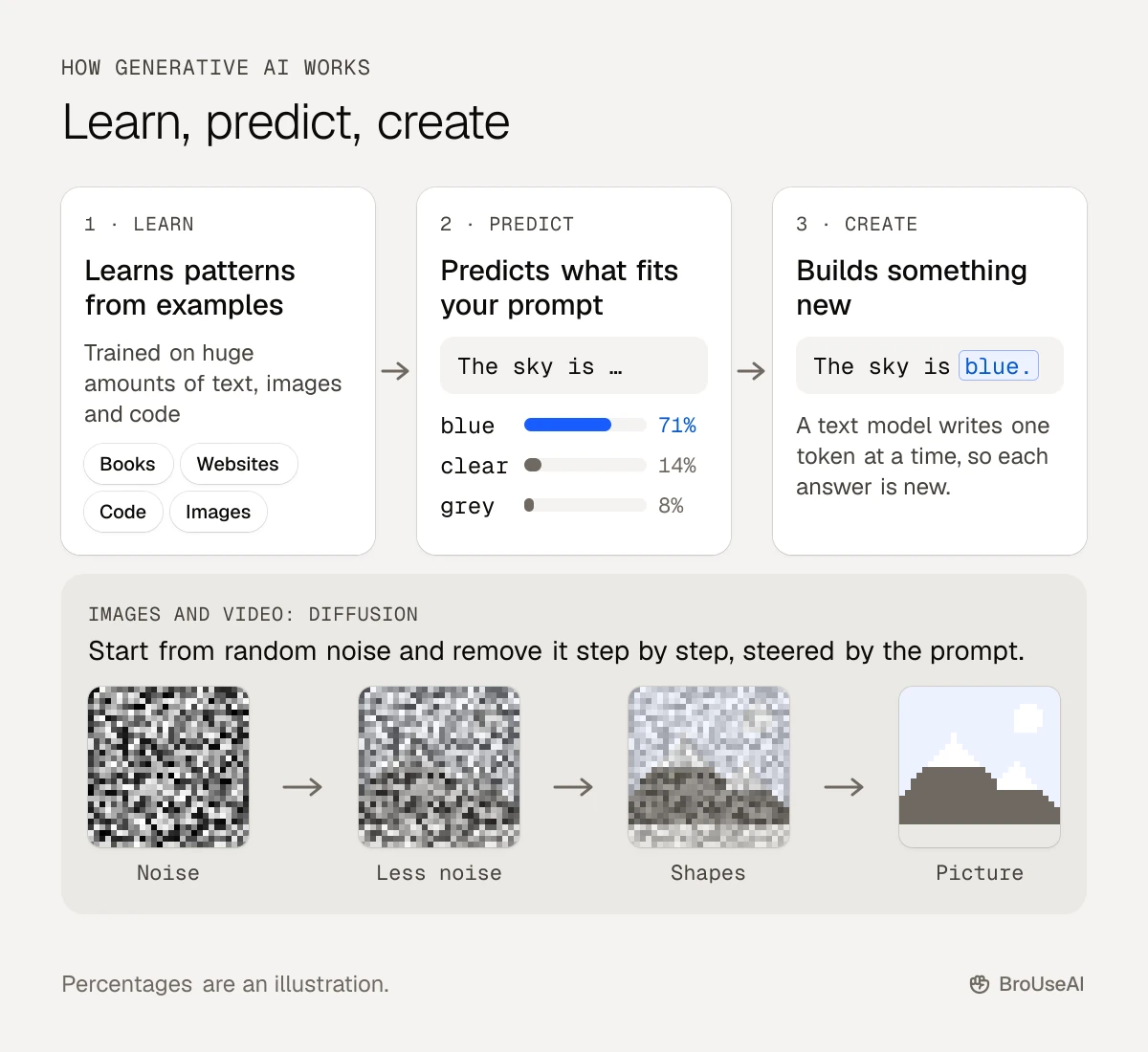
1. It learns from examples
A model is trained on a very large collection of examples, its training data: books, websites and code for a text model, or pictures with captions for an image model. During training, it adjusts billions of internal settings, called parameters, until it gets good at predicting what typically comes next or what typically looks right.
2. It turns your prompt into a prediction
Text models such as the ones behind ChatGPT, Claude and Gemini are large language models (LLMs). They break text into small pieces called tokens and write an answer one token at a time, each time picking a likely next piece based on your prompt and everything written so far. Most are built on the transformer, a design introduced by Google researchers in the 2017 paper "Attention Is All You Need", which lets the model weigh how every word relates to every other word.
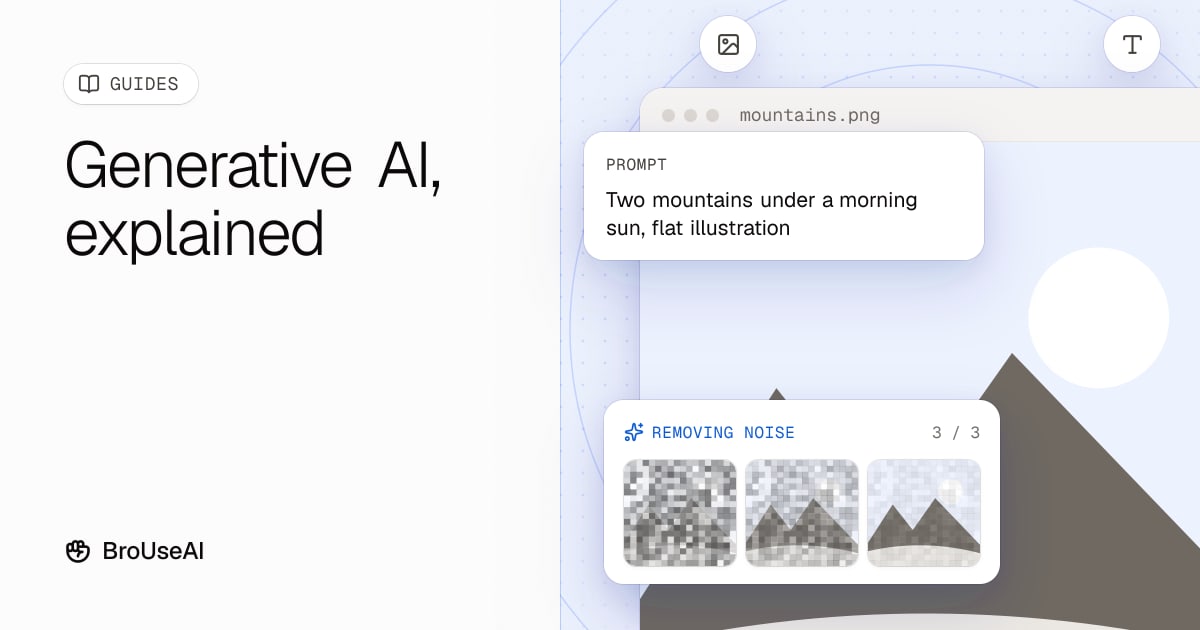
Image and video models often use a diffusion model. They start from random noise and remove it step by step, steering each step toward a picture that matches your description, a little like a photo slowly coming into focus.
3. It produces something new
The result is new: the model doesn't paste a stored answer, it generates one. That's why asking the same question twice can give two different answers, and why it can write in a style it has never seen in exactly that combination.
Many models today are multimodal: one model can read text and images, listen to speech and reply with text, images or voice.
What generative AI can make
| Content | What it does | Example tools |
|---|---|---|
| Text | Drafts, summaries, translations, answers, brainstorming | ChatGPT, Claude, Gemini |
| Images | Pictures, illustrations, product shots and edits from a description | Midjourney, Adobe Firefly |
| Video | Short clips from text or a still image, often with sound | Google Veo, Sora 2 |
| Audio | Natural voiceovers, music and sound effects | Murf AI, Beatoven.ai |
| Code | Writing, explaining and fixing code | GitHub Copilot, Cursor |
You can browse hundreds more in the AI tools directory, grouped by category.
What generative AI is good at
- Getting past the blank page. First drafts, outlines and ideas in seconds.
- Summarising and explaining. Turning a long report, contract or video transcript into the key points, or explaining a hard topic in simple words.
- Changing format and tone. Notes into an email, a blog post into social posts, formal into friendly, English into Spanish.
- Making visuals without design skills. Mock-ups, illustrations, thumbnails and product photos.
- Speeding up routine work. Code snippets, spreadsheet formulas, meeting notes and replies to common questions.
The limits and risks of generative AI
Generative AI predicts what is likely, not what is true. Keep these limits in mind:
- It can be confidently wrong. Models sometimes invent facts, quotes or sources, known as hallucinations. Check anything important.
- Its knowledge has a date. A model only knows what was in its training data up to its knowledge cutoff, unless it can search the web.
- It can repeat bias. Patterns in the training data, including unfair ones, can show up in the output. Read more about AI bias.
- Copyright is still being argued over. Courts and lawmakers are still deciding how training and AI output fit copyright law. See AI and copyright.
- It can be misused. The same tools that make product videos can make deepfakes. Our guide on how to spot AI-generated images explains what to look for.
- Your data may be stored. What you type may be kept and, on some plans, used for training. Follow our AI privacy tips before pasting anything sensitive.
The US National Institute of Standards and Technology (NIST) lists risks like these in its generative AI risk profile, a useful checklist if you're bringing AI into a business.
How to start using generative AI
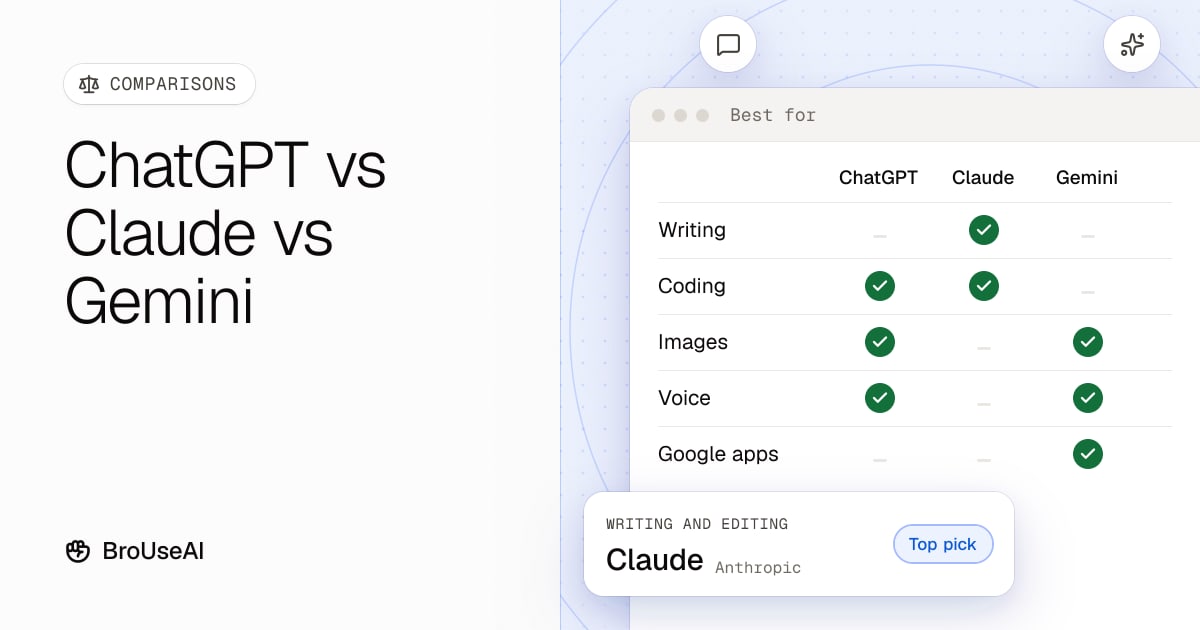
- Pick one general assistant with a free plan, such as ChatGPT, Claude or Gemini. Our ChatGPT vs Claude vs Gemini comparison helps you choose.
- Try it on a real task from your week: an email, a summary, a plan.
- Be specific. Say who it's for, what you want and the format, as in our tutorial on writing better AI prompts.
- Improve the answer by replying, rather than starting again: "shorter", "more formal", "add an example".
- Check and edit the result before you use it. You are still the author.
The bottom line
Generative AI creates new text, images, audio, video and code by learning patterns from huge amounts of data and predicting what fits your prompt. It is a powerful helper for drafting, summarising, designing and coding, but it can be wrong, biased or out of date. Use it to go faster, and keep your own judgement for what's true and what's good.
Frequently asked questions
What is an example of generative AI?
ChatGPT writing an email from a short description is generative AI. So are Midjourney creating an image from a sentence, Google Veo making a video clip from a prompt and GitHub Copilot suggesting code as you type.
Is generative AI the same as AI?
No. Generative AI is one type of AI. Artificial intelligence also includes systems that recognise faces, recommend products, translate speech or predict demand without creating new content.
How is ChatGPT related to generative AI?
ChatGPT is a generative AI app. It runs on large language models that generate text one token at a time, and newer versions can also create images and speak.
Is generative AI free to use?
Many generative AI tools have free plans with daily limits, including ChatGPT, Claude and Gemini. Paid plans, usually around $20 a month, add higher limits, newer models and extra features.
Sources
- IBM, What is generative AI?
- Vaswani et al., Attention Is All You Need (2017), the paper that introduced the transformer
- Ho, Jain and Abbeel, Denoising Diffusion Probabilistic Models (2020)
- NIST, AI Risk Management Framework: Generative AI Profile (NIST AI 600-1)
- Stanford HAI, AI Index Report