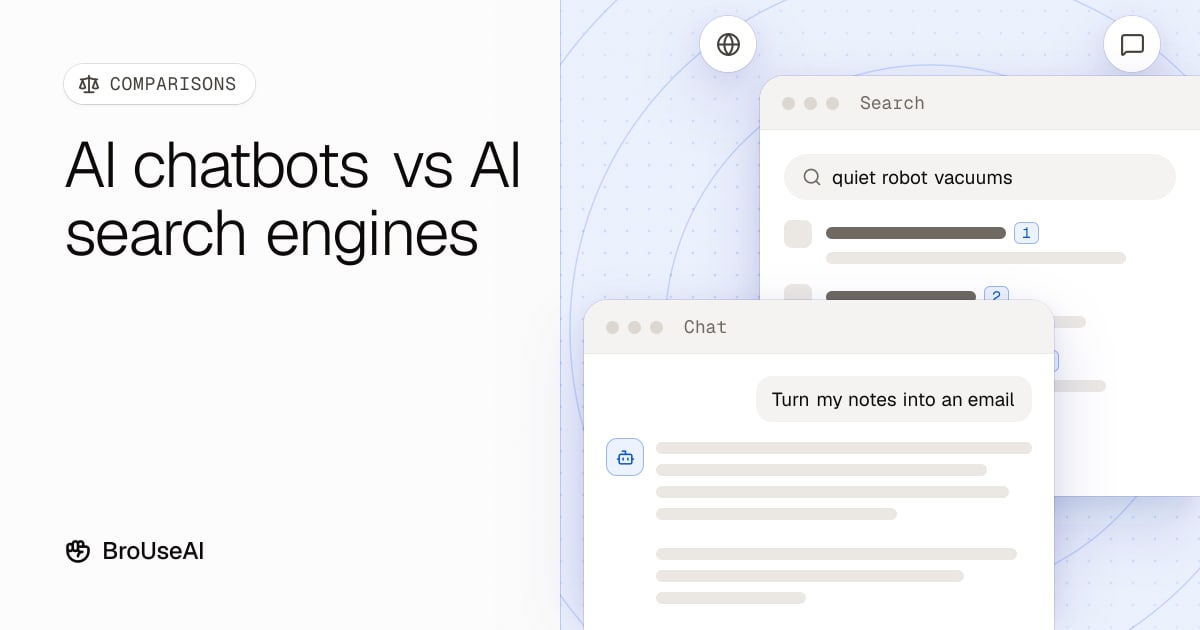
Use an AI search engine when you need current facts with sources you can check, and an AI chatbot when you need something made or worked through: a draft, a plan, an explanation or an analysis of your own material. The two have grown closer, since most chatbots can now search the web and most AI search engines can chat, but each is still built around a different job.
The short answer
| AI search engine | AI chatbot | |
|---|---|---|
| Built for | Finding and summarising information from the web | Writing, reasoning and working with your own content |
| Answers come from | Web pages it searches for each question | The model's training, plus web search or files when used |
| Sources | Cited inline by default, so you can check them | Shown when it searches; often absent otherwise |
| Freshness | Current, because it searches every time | Limited by a knowledge cutoff unless it searches |
| Best at | Research, fact-finding, comparing products, news | Drafting, editing, brainstorming, coding, analysis |
| Examples | Perplexity | ChatGPT, Claude, Gemini, Microsoft Copilot |
How AI search engines work
An AI search engine runs a web search for your question, reads the top results and writes an answer from them, with numbered citations linking to each source. This technique of answering from retrieved documents is called retrieval-augmented generation, and it keeps answers grounded in what the sources actually say.
Strengths:
- Up to date. It searches each time, so it can answer questions about this week.
- Checkable. Citations let you open the source and confirm a claim in seconds.
- Fast research. It condenses ten tabs of reading into one summary with links.
Limits:
- Only as good as its sources. If the top results are thin or wrong, so is the answer.
- Less suited to making things. Long drafts, rewrites and creative work aren't its focus.
How AI chatbots work
An AI chatbot answers from a large language model trained on a huge amount of text. Without searching, it knows what was in its training data up to its knowledge cutoff. Most popular chatbots can also search the web, read files you upload and use other tools when needed.
Strengths:
- Making and transforming content. Drafts, summaries of your own documents, translations, code and plans.
- Reasoning through problems. Step-by-step explanations, comparisons of options you give it, and back-and-forth refinement.
- Working with your material. Paste in notes, a spreadsheet or a contract and ask questions about it.
Limits:
- It can be confidently wrong. Without sources, mistakes, known as hallucinations, are harder to spot.
- It can be out of date on recent events unless it searches.
Which should you use?
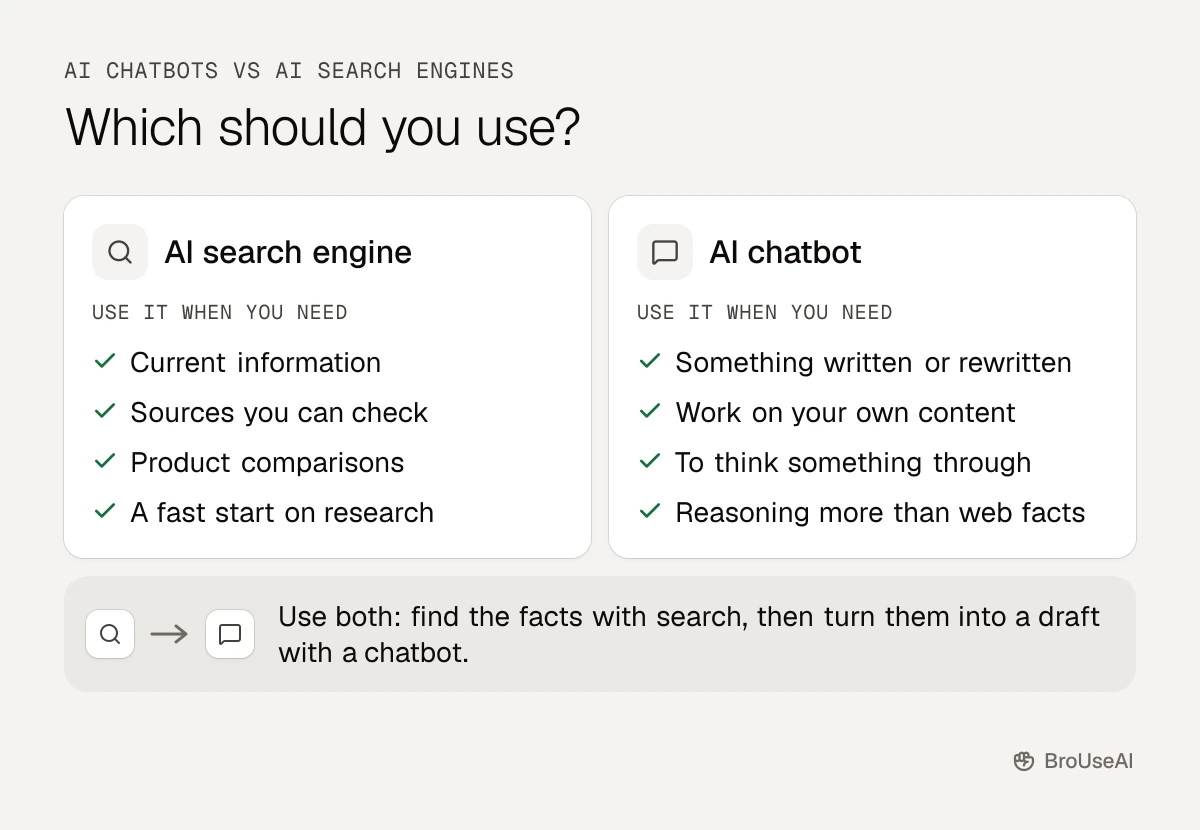
Use an AI search engine when…
- You need current information: news, prices, release dates, opening hours.
- You need sources you can cite or check, for example for a report or a purchase decision.
- You're comparing products or services and want the latest reviews and specs.
- You're starting research on an unfamiliar topic and want the key sources fast.
Use an AI chatbot when…
- You need something written or rewritten: emails, posts, reports, product copy.
- You're working with your own content: summarising a document, analysing data, reviewing code.
- You want to think something through: brainstorm, plan a project, explore options.
- The answer depends on reasoning rather than facts from the web.
Use both together
Many people get the best results by combining them: research the facts with an AI search engine, then paste the key points and sources into a chatbot to turn them into a draft, a plan or a table. And whichever you use, check important facts against the original source.
Tips for better answers from either
- Be specific. "Best laptop for video editing under 1,500 dollars, available in the UK" beats "best laptop". Our prompt writing tutorial covers this in depth.
- Ask for sources, and open them for anything that matters.
- Turn on web search in your chatbot when the question is about recent events.
- Keep private data private. Don't paste confidential information into a public tool.
To find more options, browse the AI search engines and AI chatbots in the directory, and use our checklist for choosing an AI tool to test a shortlist.
Frequently asked questions
Is an AI search engine better than Google?
They do different things well. An AI search engine gives you a written answer with sources, which is faster for questions that need a summary. A traditional search engine is better when you want to browse many sites yourself, find a specific page or shop around.
Can ChatGPT search the web?
Yes. ChatGPT, like most major AI chatbots, can search the web and show the sources it used. Check the tool's settings or plan to see when search is available and whether it runs automatically or needs to be switched on.
Are AI search engine answers always accurate?
No. They are more checkable than answers without sources, but they can still misread a page or rely on a poor source. Open the citations for anything important before you rely on it.