
Amazon Bedrock
The easiest way to build and scale generative AI applications with foundation models
Paidaws.amazon.comAdded 26 Feb 2024
The easiest way to build and scale generative AI applications with foundation models
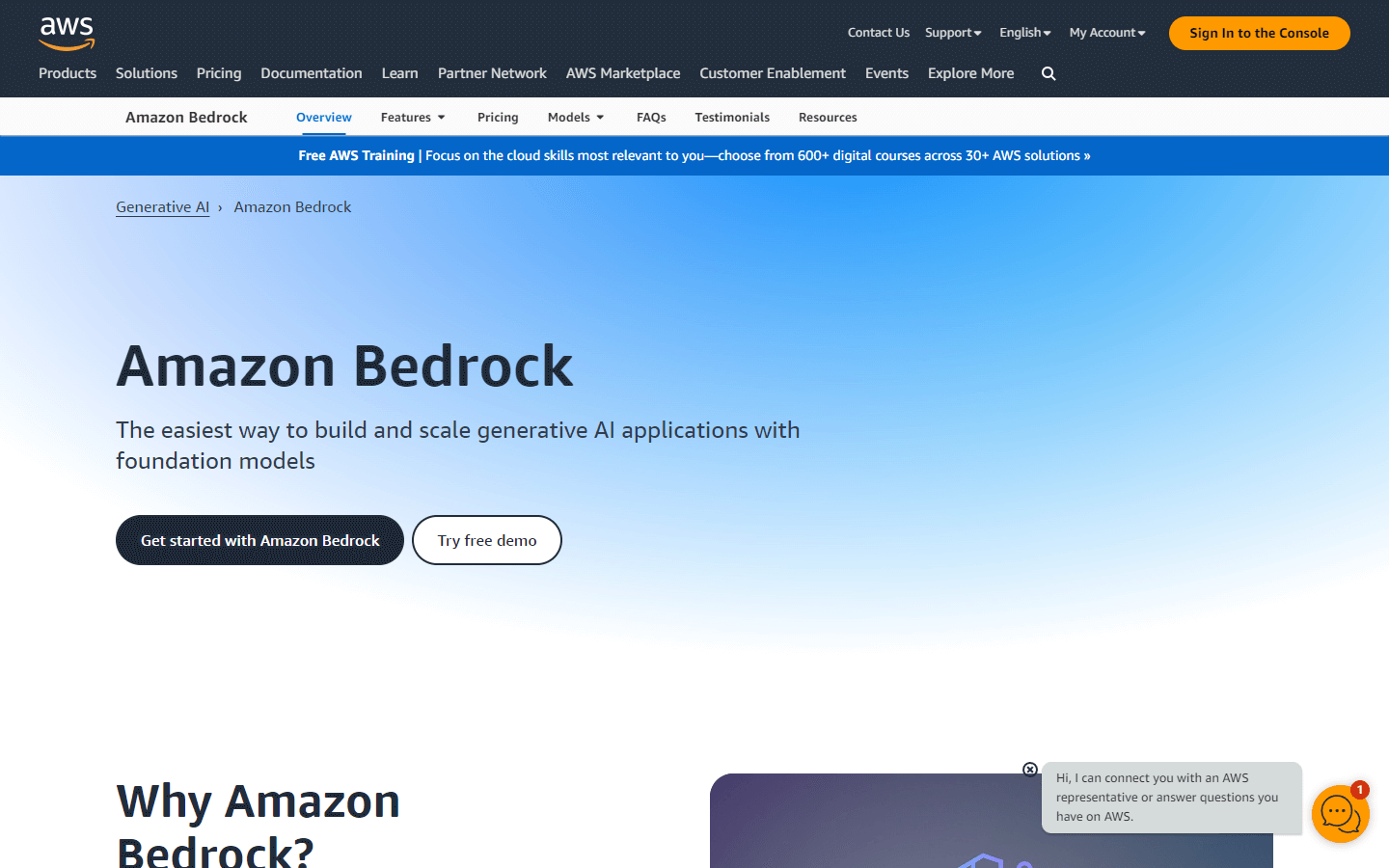
Amazon Bedrock is a service offered by Amazon Web Services (AWS) that helps developers build applications using generative AI. It provides two key functionalities:
Access to foundation models: Amazon Bedrock offers a selection of powerful foundation models (FMs) from various leading AI companies, including Amazon itself. These FMs are essentially pre-trained AI models that can be fine-tuned for specific tasks, making it easier for developers to get started with generative AI applications.
Tools for building generative AI applications: In addition to providing access to FMs, Amazon Bedrock also offers a set of tools and functionalities that developers can use to build secure and responsible generative AI applications. These tools include:
Fine-tuning: This allows developers to customize FMs with their own data, improving their performance for specific tasks.
Retrieval-Augmented Generation (RAG): This technique combines the strengths of generative models with traditional retrieval methods, leading to more informative and relevant outputs.
Building AI agents: Developers can create AI agents that interact with enterprise systems and data sources to perform specific tasks.
Overall, Amazon Bedrock aims to simplify and accelerate the development of generative AI applications by providing a platform with the necessary tools and resources, all while emphasizing security, privacy, and responsible AI practices.
Access to a variety of foundation models (FMs): Choose from high-performing FMs from different AI companies through a single API.
Model evaluation: Evaluate FMs using automatic and human evaluations to select the best one for your needs.
Private model customization: Fine-tune FMs with your own data using techniques like fine-tuning and Retrieval-Augmented Generation (RAG).
Building AI agents: Create agents that interact with your enterprise systems and data sources to automate tasks.
Serverless experience: Get started quickly, manage models, and deploy them into applications without managing infrastructure.
Knowledge Bases: Integrate and manage your company data for more contextual and relevant responses from FMs.
Content creation: Generate different creative text formats like poems, scripts, musical pieces, marketing copy, or code based on user prompts.
Information retrieval: Search and summarize vast amounts of information to answer user questions or generate reports.
Machine translation: Translate text between multiple languages with improved accuracy and fluency.
Chatbots and virtual assistants: Develop chatbots that can answer customer queries, provide personalized recommendations, or schedule appointments.
Code generation: Automatically generate code snippets or complete specific coding tasks based on user input, improving developer productivity.
Personalized marketing: Generate targeted marketing content tailored to individual customer preferences and demographics.
Data analysis and reporting: Analyze complex datasets and automatically generate reports with insights and visualizations.
Product design and development: Brainstorm and generate new product ideas, descriptions, or marketing materials.
Scientific research: Analyze research papers, generate hypotheses, or summarize findings to accelerate scientific discovery.
Education and training: Develop personalized learning materials, generate practice questions, or provide feedback to students.
Faster development: Get started quickly with pre-trained models and avoid building from scratch.
Improved performance: Access high-performing foundation models for various tasks.
Customization: Fine-tune models with your data for improved accuracy and relevance.
Scalability: Easily scale resources as your AI needs grow.
Security and privacy: Benefit from Amazon's security infrastructure and responsible AI practices.
Cost-effective: Pay only for the resources you use with the serverless model.
Variety of models: Choose from a diverse selection of foundation models for different tasks.
Integration: Integrate AI capabilities seamlessly with existing applications and data sources.
Knowledge base support: Leverage knowledge bases for more context-aware and informative outputs.
Simplified management: Manage and deploy models without managing infrastructure.
Complexity: Configuring and using advanced features might require technical expertise.
Cost considerations: Costs can accumulate depending on usage and chosen models.
Limited control: Some customization capabilities might be restricted compared to building your own models.
Vendor lock-in: Dependence on Amazon's platform might limit portability options.
Potential bias: As with any AI model, potential for bias inherited from the chosen model exists.
Explainability and interpretability: Understanding how models arrive at their outputs can be challenging.
Limited transparency: The inner workings of some foundation models might not be fully transparent.
Ethical considerations: Careful consideration of ethical implications in using generative AI is required.
Access control: Managing access to sensitive data and outputs becomes crucial.
Evolving technology: Keeping up with advancements in the rapidly evolving field of AI can be demanding.

Fix Technical Debt Automatically

The AI community building the future

The world’s most widely adopted AI developer tool.

AI Powered Mind Map, Flowchart, Whiteboard.

A 12 billion parameter rectified flow transformer capable of generating images from text descriptions
 Opens site
10+ customizable AI demo apps: pick one, make it yours, launch your startup quickly and start making money

Claude Code: AI coding agent for terminal and IDE

The documentation you want, effortlessly

AI project manager to speed up software development

Automate as fast as you can type

Access image, video, and language models via one API without monthly subscriptions

Fast, realistic text-to-video with native audio
Articles, AI terms and videos related to Development.
 OneKDPAI book & KDP cover generator with free KDP toolsSeedRouterAccess image, video, and language models via one API without monthly subscriptions
 CommentWatchDogHide and delete spam comments on Facebook and Instagram ads
 Adobe Firefly Background RemoverAI tool that removes photo backgrounds and outputs a transparent PNG — free to use.
 AIclicksTrack and grow your brand's visibility in ChatGPT and AI search
 MenuFormaFree AI QR code menu & online ordering for restaurants
 Capafy AIAI Video & Image Generator in One Place
 GenjutsuTransform one video into endless variations with AI.
 LookRoll.aiAI video & image generator: Kling, Seedance, Veo, more
 PlimoAI images and videos from trending templates or your idea