
Abacus AI
The World's First Super Assistant for Professionals and Enterprises
Paidabacus.aiAdded 23 Oct 2025
The World's First Super Assistant for Professionals and Enterprises
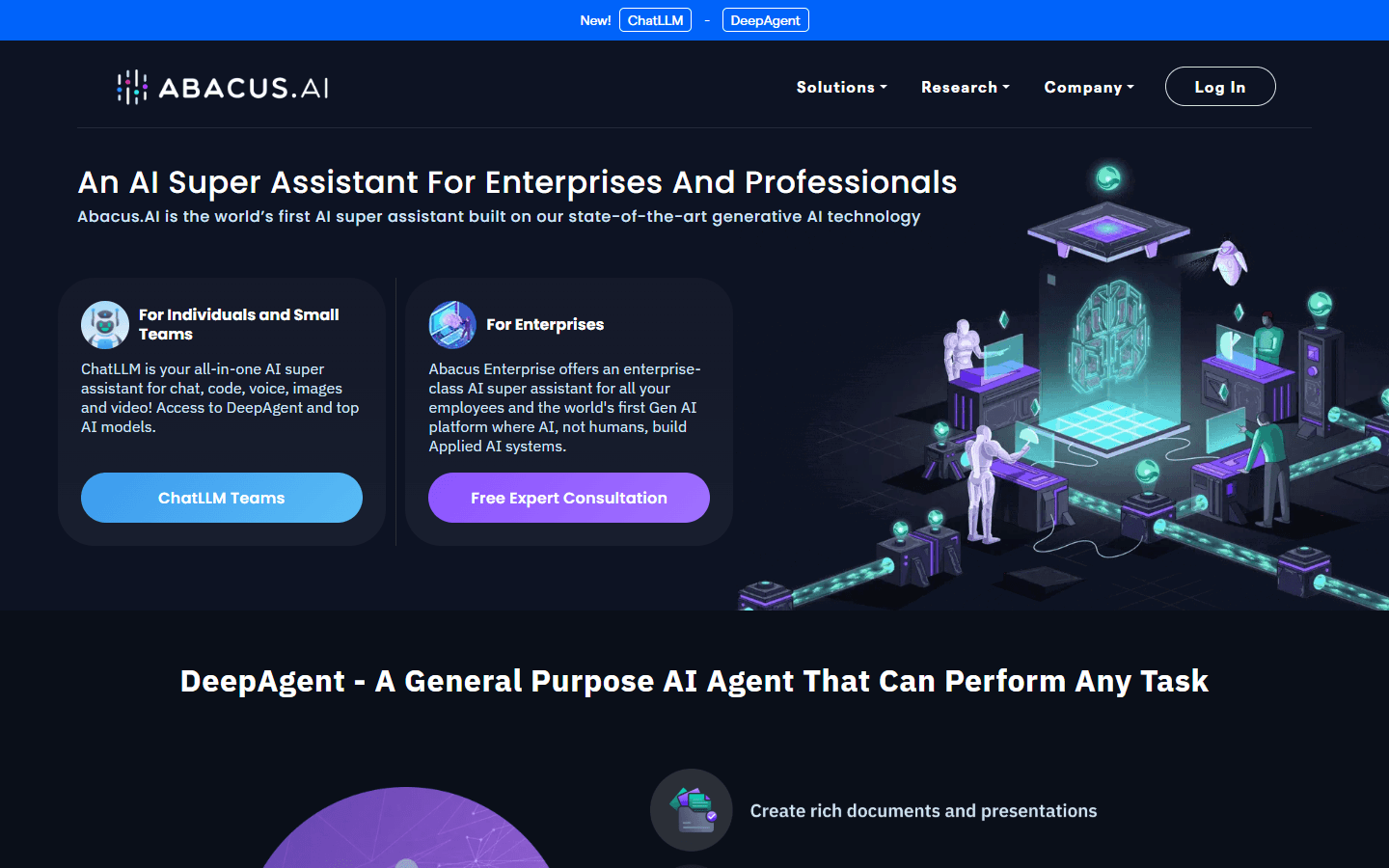
Abacus.AI is positioned as the world's first AI super assistant tailored for professionals and enterprises, combining state-of-the-art generative AI, LLM orchestration, and agent-based automation into a single platform. Built to accelerate decision making and automate complex workflows, Abacus.AI lets teams deploy custom ChatLLMs, run multimodal agents, and create an AI brain that connects to enterprise systems and data sources.
Whether you are a developer building AI-driven products or an IT leader enabling employees, Abacus.AI provides the tools required to operationalize applied AI at scale. Under the hood Abacus.AI delivers a modular stack: access to top open-source and proprietary LLMs, DeepAgent general purpose agents that can perform tasks across applications, and a visual workflow builder for composing pipelines that include SQL or Python for data wrangling.
The platform supports multimodal inputs (text, code, images, voice, and video), monitoring and evaluation of model outputs, and real-time streaming visualization for telemetry and data insights. For enterprises, Abacus.AI also offers single sign-on, multiple deployment options, and security and compliance features required by regulated industries. What makes Abacus.AI unique is the blend of production-grade tooling and research-driven models.
The company publishes and supports open-source models and benchmarks such as Smaug, Dracarys, Giraffe, and LiveBench, enabling customers to benefit from high-performing LLMs alongside reproducible evaluation metrics. Abacus.AI emphasizes model reliability by providing LLM evaluation dashboards, guardrails that monitor and verify responses, and an AI engineer concept that automates the construction of applied AI systems. You can request an expert consultation or learn more at https://abacus.ai.
For teams, ChatLLM offers a plug-and-play experience with access to DeepAgent and top models, while Abacus.AI Enterprise provides AI brains and integrations that scale across an entire organization.

AI Implementation Hub for Non-Technicals
 Opens site
 Accelerate development with Blackbox AI's multi-model platform

One API for 80+ frontier AI models across text, image, audio and video.

Siesta AI is an all-in-one platform for SME teams to adopt AI the right way.

AI support that feels human
AI terms and videos related to Enterprise AI Platforms.
 Adobe Firefly Background RemoverAI tool that removes photo backgrounds and outputs a transparent PNG — free to use.
 AI Overviews TrackerTrack website mentions and citations across six AI engines
 GenjutsuTransform one video into endless variations with AI.
 WasItAIDetect whether an image was AI-generated or camera-captured.
 AI Image HumanizerHumanize AI-generated images while preserving their visible appearance
 C2PA RemoverCheck and remove C2PA content credentials