
Winston AI
The most trusted AI detector
Overview
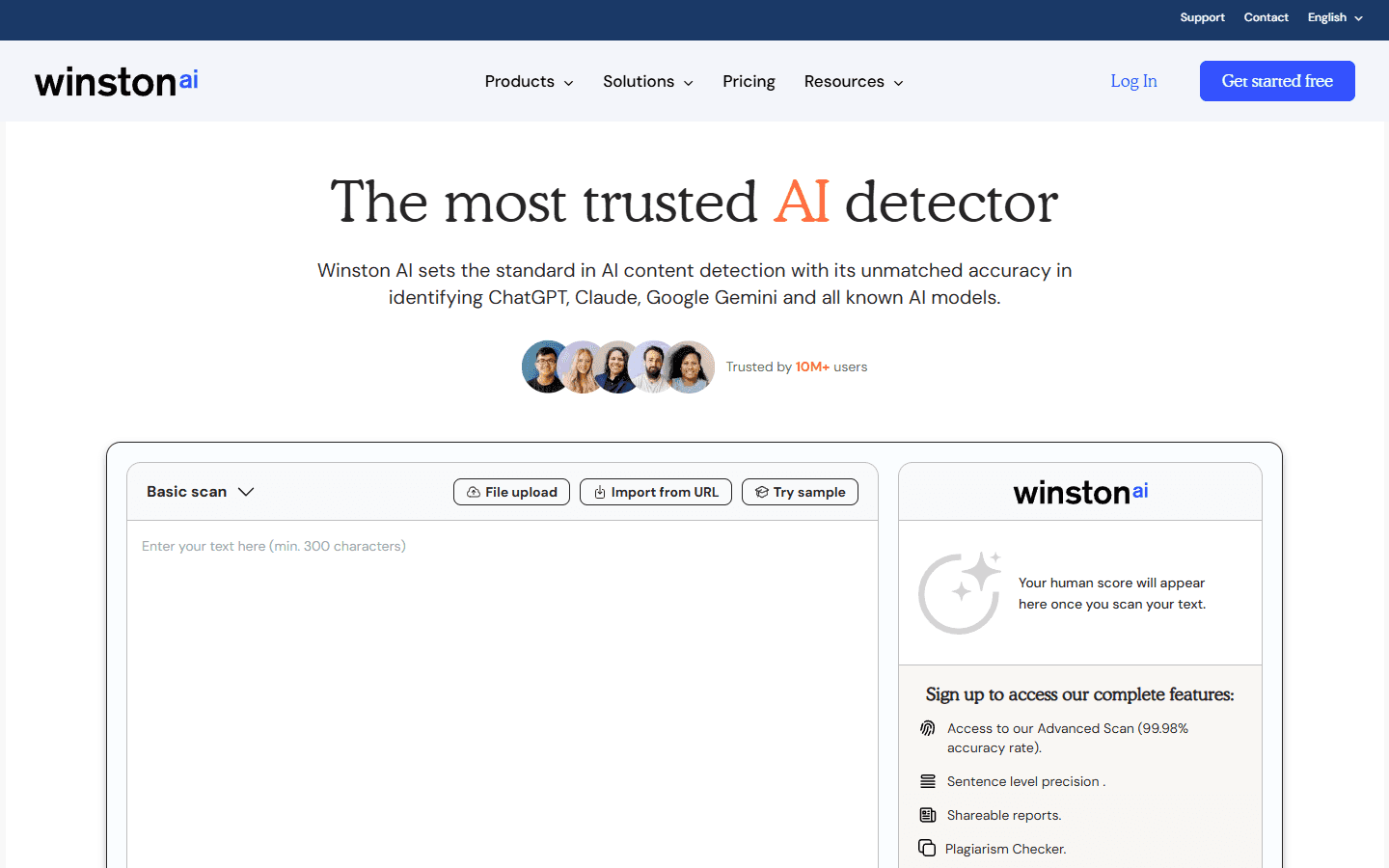
Winston AI (https://gowinston.ai/) is a purpose-built AI content detection platform designed to help institutions, publishers, SEO teams, and writers confirm content authenticity and preserve trust. As the industry-leading AI detector, Winston AI combines advanced natural language processing, machine learning, and a human-reviewed training dataset to flag AI-generated text from models such as ChatGPT, Google Gemini, Claude and more.
The platform returns a human score and an AI likelihood score on a 0-100 scale and highlights suspicious sentences so you can see precisely which passages triggered detection. The workflow is simple: create a free account, paste text or upload files (.docx, .png, .jpg), and run a quick or advanced scan. Winston AI supports OCR to extract text from images and handwriting, offers sentence-level precision, and produces shareable PDF reports for audits, academic reviews, or editorial workflows.
For high-volume and integrated environments, Winston AI provides an enterprise API, Zapier integrations, and browser plugins so detection fits into your existing tooling. What sets Winston AI apart is a focus on accuracy and transparency. The detection model is trained on a massive, diverse dataset that includes human-reviewed examples to reduce false positives.
Detection algorithms are updated frequently to keep pace with new LLM versions and evasion techniques such as paraphrasing or humanization. Winston AI is SOC 2 aware and GDPR compliant, and the company explicitly states that user content is not used to train detection models. The platform also bundles advanced plagiarism checking, readability and grammar feedback, and AI image and deepfake detection into one integrity suite.
Winston AI serves a broad set of use cases: educators enforcing academic honesty, publishers and SEO teams protecting rankings, HR and hiring teams verifying candidate submissions, and freelance writers checking originality before publication. A free tier offers a trial credit allotment and basic scans, while paid plans scale credits, team seats, and enterprise features.
To get started or learn more about integrations and pricing, visit Winston AI at https://gowinston.ai/ and register for a free account to run your first scan.
Core Features
- 99.98% industry-leading AI detection accuracy across major LLMs
- Sentence-level precision to pinpoint suspicious sentences quickly
- Advanced plagiarism checker with highlighted sources and matches
- OCR uploads for scanned documents, images, and handwriting
- Shareable PDF reports for audits, clients, and academic records
- Multilingual detection covering English, Spanish, Chinese, and more
- Enterprise API and Zapier integrations for workflow automation
- Regular model updates to counter paraphrasing and humanizers
Use Cases
- University plagiarism checks and academic integrity enforcement
- SEO teams auditing content to avoid AI-related ranking penalties
- Newsrooms validating reporter copy and guest submissions
- Publishing houses screening manuscripts for synthetic text
- HR teams verifying writing samples and candidate assessments
- Content agencies ensuring client deliverables are human-authored
- Legal and compliance reviews for contract and policy documents
- Freelance writers pre-publishing originality and tone checks
- EdTech platforms integrating detection via the Winston AI API
- Forensics teams analyzing images and deepfakes for authenticity
Pros & Cons
Pros
- Extremely high detection accuracy
- Sentence-level visibility for precise review
- Integrated plagiarism detection
- OCR support for images and handwriting
- Multilingual detection coverage
- Shareable, professional PDF reports
- Enterprise API and integrations
- Regular weekly model updates
- GDPR mindful and secure handling
- Free trial and tiered plans
Cons
- High-volume use can be credit intensive
- Detection is probabilistic, not absolute
- Advanced features require paid plan
- Very short snippets reduce detection confidence
- Some rare languages have limited support
- False positives possible on atypical writing
FAQs
Video Review
Winston AI Alternatives

AI Content Detector by Leap AI
Use our free AI Content detector to analyze text and see if it was generated by AI or not. AI Checker tool, 100% free forever.

Smodin
Write, Solve, Succeed

AISEO
Boost Your Google Rankings With Undetectable AI Content!

ZeroGPT
Trusted GPT-4, ChatGPT and AI Detector tool by ZeroGPT

WasItAI
Detect whether an image was AI-generated or camera-captured.

Copyleaks
AI-based text analysis to help create and protect original content

GPTZero
More than an AI detector, Preserve what's human.
Featured

Referent
AI legal agents for law firm operations

C2PA Remover
Check and remove C2PA content credentials

CommentWatchDog
Hide and delete spam comments on Facebook and Instagram ads

AI Image Humanizer
Humanize AI-generated images while preserving their visible appearance

Token360
One API for 80+ frontier AI models across text, image, audio and video.

RemoveAILabel
Remove AI labels and watermark traces from images and videos
WasItAI
Detect whether an image was AI-generated or camera-captured.

Claude Mark Remover
Remove hidden Claude marks and humanize AI-generated text.

Answer Engine Optimization
See how AI answer engines mention and cite your website.

AI Overviews Tracker
Track website mentions and citations across six AI engines